


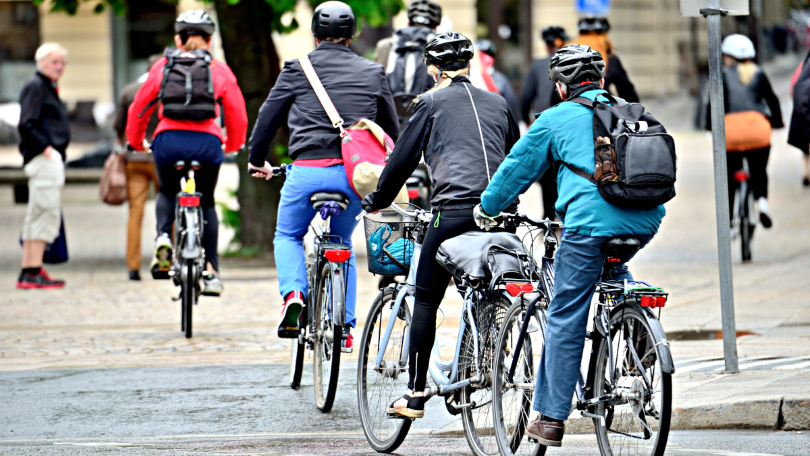
Source: Adobe Stock / connel_design
Since 2009, the German Federal Ministry of Transport (BMV) has been fundeing the representative Cycling Monitor survey, which is conducted every two years by the SINUS-Institut.
The 2025 Cycling Monitor provides another comprehensive picture of how the use of bicycles and pedelecs is perceived in Germany. For the first time, it also includes an independent representative survey among children and their parents. We now have valuable insights into how young people experience cycling, what their needs are, and what conditions are crucial for safe and motivating bicycle mobility.
The use of bicycles among adults and young people (ages 14 to 69) has slightly increased according to the survey: 41 percent of the population use a bike or pedelec (e-bike) on a regular basis. The total share of the population using a bicycle or pedelec is around 80 percent. In addition, cycling remains the transport means with the highest subjective growth potential – 55 percent of the persons surveyed want to cycle more frequently in future.
Steady high level of use – Safety remains a key issue
Bicycles and e-bikes continue to be used mainly for short daily commutes and for recreational activities. Though many people enjoy cycling and they believe it is good for their personal health and the environment, 41 percent do not feel safe in road traffic. The main reasons mentioned are the car drivers’ lack of consideration towards cyclists, pressure imposed by traffic and high speeds of motorized vehicles. Against this background, the respondents view the continued expansion of cycle paths and the physical segregation from motor vehicle traffic to be the key challenges for evolving cycling.
Children like cycling but need safe cycle paths
The 2025 Cycling Monitor’s new element is the first independent survey among children and parents. The results clearly show that cycling plays an important role in the everyday lives of children and is mostly perceived as something positive. 88 per cent of the children state that they like cycling, especially the younger ones and those whose parents cycle on a regular basis, too. The use of bicycles at a young age has a lasting impact. Children who start cycling early, by using balance bikes for example, are more likely to cycle frequently as they get older.
However, the results of the survey also show where action is required. Children mainly use their bikes for fun and in their free time, but significantly less for daily commutes to school or daycare. They feel there is too much traffic and the cycle lanes are either missing, too narrow or in a poor condition. They do not feel safe surrounded by motorized traffic, in particular big vehicles. Many children continue to ride their bikes on footpaths, despite having passed the legal age limit, either because there are no cycle lanes or because they are not adequately separated from traffic, or the overall volume of traffic makes them feel unsafe. The findings highlight the importance of safe, child-friendly and fail-safe infrastructure, particularly on routes used on a daily basis.
Overall, they show that early, safe and positive experiences with cycling lay the groundwork for long-term cycling habits, even into teenage years and adulthood.
About the ‘Cycling Monitor’ study
The Cycling Monitor is a representative study funded by the Federal Ministry of Transport and conducted by the SINUS-Institut for the ninth time in 2025. The survey of adults‑ and young people is based on a nationwide representative online‑ cross-section of people aged between 14 and 69. In addition, a separate, comprehensive survey of children aged 6 to 13 and their parents was conducted for the first time in 2025.
The Cycling Monitor is funded by the Federal Ministry of Transport as part of the guidelines for the promotion of non-capital projects to implement the National Cycling Plan (https://www.bmv.de/SharedDocs/DE/Artikel/StV/Radverkehr/nicht-investive- modellprojekte.html).
You can find the detailed results of the 2025 Cycling Monitor as well as the editions of the previous years under FURTHER INFORMATION.