



Source: BMV
When we talk about micro mobility, we are referring to smaller vehicles with electric drivetrains, such as electric scooters and Segways. They are referred to by the term Personal Light Electric Vehicles.
These vehicles are battery-driven and thus emit zero emissions. A special feature of many of these vehicles is that they are very small and lightweight, allowing for a foldable and portable design. This enables the users to take the vehicles on public transport, which is why they have a special added value regarding linking different means of transport and covering short distances in particular (last mile mobility).
With the entry into force of the Personal Light Electric Vehicles Regulations on 15 June 2019, the foundations were laid to allow the use of Personal Light Electric Vehicles with a handlebar or a stanchion on public roads.
In addition, a list of the general type approvals issued for Personal Light Electric Vehicles has been published on the Federal Motor Transport Authority’s (KBA) website which can be found here:
Link to the Federal Motor Transport Authority (KBA) - List of the general type approvals.
We thereby want to allow for new forms of modern, environmentally-friendly and clean mobility, while at the same time ensuring safety on our roads.
Below, you can find the most important questions and answers concerning Personal Light Electric Vehicles.
Where am I allowed to use Personal Light Electric Vehicles?
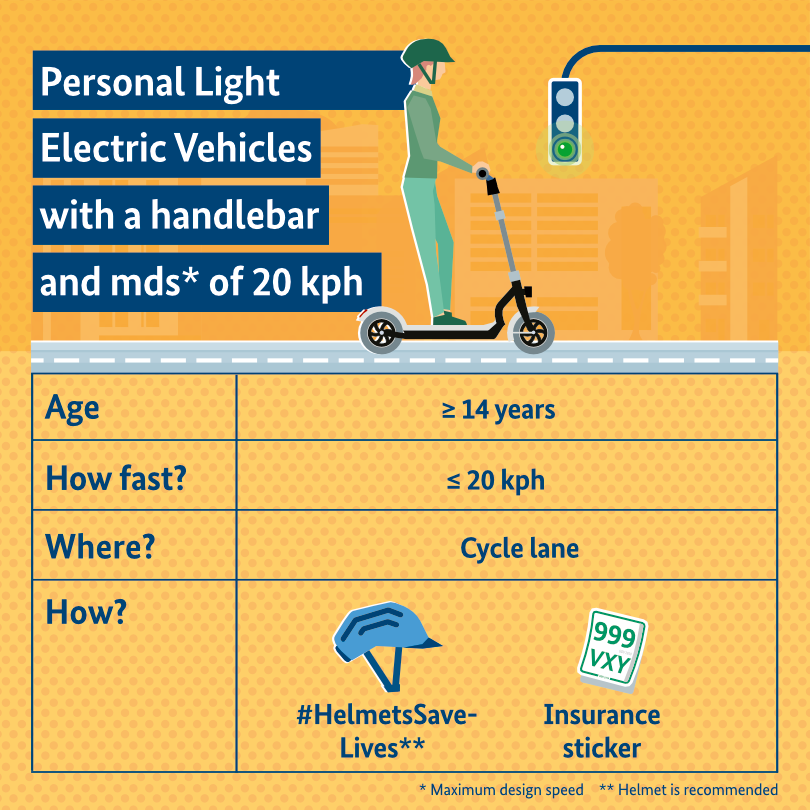
As a general rule, Personal Light Electric Vehicles must be operated on traffic spaces for cyclists where such spaces are available. If there is a physically separated cycle track, an advisory cycle lane or a cycle lane, Personal Light Electric Vehicles must use it. This applies regardless of whether the use of the cycle track or lane is mandatory for cyclists or not. The rules of the road that apply to Personal Light Electric Vehicles differ here from those applying to bicycles. If there are no physically separated cycle tracks or cycle lanes, Personal Light Electric Vehicles can be used on the carriageway and, outside built-up areas, also on the hard shoulder.
The new rules of conduct introduced by the recast of the Regulations on the Use of Personal Light Electric Vehicles on Public Roads (eKFV) will not take effect until 1 March 2027.
Can Personal Light Electric Vehicles be used on the sidewalk when the motor has been switched off?
No. Even if the motor has been switched off, Personal Light Electric Vehicles may only be operated on the designated traffic spaces. It is not possible to change the category of a vehicle in operation, for example by switching off the motor.
Do I need a driving license?
No. There is no driving license obligation or obligation to carry a test certificate for motor-assisted bicycles.
What is the minimum age?
Personal Light Electric Vehicles can be used from the age of 14 years and above.
Do I have to insure my Personal Light Electric Vehicle?
Yes. Personal Light Electric Vehicles are motor vehicles and thus must be insured. Due to their small size and special design features, a small insurance sticker has been introduced for these vehicles.
Am I allowed to operate a Personal Light Electric Vehicle under the influence of alcohol?
The blood alcohol limit of 0.05 % laid down in Section 24a of the German Road Traffic Act also applies to Personal Light Electric Vehicles. However, even with a blood alcohol concentration (BAC) of 0.03 % or more, you are liable to prosecution if you are no longer able to drive safely while under the influence of alcohol. For under 21-year-olds and novice drivers in the probationary period, the zero alcohol limit applies here, too. The relevant penalty and fine regulations governing the operation of motor vehicles in road traffic apply here. For example, a BAC of 0.05 % may result in a fine of € 500 and a driving ban for 1 month. In addition, 2 penalty points will be recorded in the Register of Driver Fitness.
What else is prohibited?
No persons other than the rider may be carried on Personal Light Electric Vehicles. It is also prohibited to carry objects on the footboard or handlebar/stanchion if this impairs safe vehicle operation and road safety. Footpaths and pedestrian zones may only be used if expressly permitted by the additional sign "Except personal light electric vehicles". Hooking up to other vehicles and obstructing or endangering other road users is also prohibited. In addition, the general road traffic regulations apply, in particular the requirement of constant care and mutual respect.
Can Personal Light Electric Vehicles be carried on public transport?
The Federal Ministry of Transport supports the carriage of Personal Light Electric Vehicles on public transport, however it cannot oblige transport operators to allow for it.
In general, the rules on the carriage of objects on local public transport apply. Details can be found in Section 11 of the Regulations on the General Conditions of Carriage for Tram and Trolleybus Services and Regular Motor Vehicle Services and, where applicable, the special conditions of carriage of the respective transport operator. Rules on carriage by railway undertakings might also be found in the special conditions of carriage of the transport operator concerned. The carriage of Personal Light Electric Vehicles must not jeopardize safe and orderly operations or inconvenience other passengers.
What are the key elements of the regulations?
Personal Light Electric Vehicles with the following features are allowed to use public roads:
- handlebars or stanchions,
- maximum design speed between 6 kph and 20 kph,
- continuous rated power of max. 500 W (max. 1,400 W for self-balancing vehicles),
- minimum road safety standards (e.g. regarding braking and lighting systems, dynamics of vehicle movements and electrical safety),
- the vehicle must have been issued with a general type approval or individual type approval and bear a valid insurance sticker.
Source: BMV
Do I need to retrofit my Personal Light Electric Vehicle after the eKFV recast takes effect?
No.
Personal Light Electric Vehicles that have already been purchased and granted a general or an individual type approval may continue to be used. No retrofitting is required for these vehicles. The new technical regulations will only apply to Personal Light Electric Vehicles manufactured from 2027 onwards.
What rules apply to Personal Light Electric Vehicles in other EU countries?
Since there is no uniform European framework, the requirements to be met by Personal Light Electric Vehicles vary between the Member States of the European Union (EU).
I live abroad. Can I use my Personal Light Electric Vehicle, which is normally located abroad, also in Germany?
This is only possible under certain conditions, as there is no uniform European framework.
The basic requirement for this is that the Personal Light Electric Vehicle in question has been granted type approval by a Member State of the European Union or a Contracting Party to the Agreement on the European Economic Area.
If this type approval has been granted with a higher maximum design speed, greater continuous rated power, greater vehicle mass or larger vehicle dimensions than is permitted in Germany, the Personal Light Electric Vehicle may not be used in Germany. In Germany, only Personal Light Electric Vehicles with the following features are allowed to use public roads:
- handlebars or stanchions,
- maximum design speed between 6 kph and 20 kph,
- continuous rated power of up to 500 watts (up to 1,400 watts for self-balancing vehicles),
- a maximum vehicle mass (excluding rider) not exceeding 55 kg as well as
- a total width not exceeding 700 mm, a total height not exceeding 1,400 mm and a total length not exceeding 2,000 mm.
The type approval granted for the Personal Light Electric Vehicle must be carried when using the vehicle. An EC declaration of conformity is not an operating permit.
In addition, proof of third-party vehicle insurance cover as required by the Act on Compulsory Insurance for Foreign Parties must be provided. If this is not provided by the foreign insurance company, a frontier insurance policy for the Personal Light Electric Vehicle must be obtained before crossing the border. Where no proof of insurance can be presented during a check, the Personal Light Electric Vehicle may be impounded until such proof is provided.