



Source: German Accident Prevention Organization (Deutsche Verkehrswacht e.V.)
In Germany, 29,273 children were involved in road traffic accidents in 2025. 74 of them were killed; 31 were passengers in a passenger car, 22 pedestrians, 13 were cyclists and 8 died in other types of road accidents.
Protecting children is a priority for the Federal Ministry of Transport (BMV). For this reason, we support different science-based and creative programmes and measures to increase road safety for children, where everybody involved – whether parents, kindergartens or schools – is highly committed. There are different ways to teach children how to become careful and responsible road users in the future.
Road safety education with Pumuckl

Source: BMV
Road safety education is vital – and anything but boring. This is illustrated by the Ministry’s new Pumuckl campaign, which promotes greater road safety. The ten fun videos target children and parents. Together with the popular children’s figure Pumuckl, known from the series of books and cartoons, they learn which rules they need to follow, how to safely cross the road and what to bear in mind when turning. Each video provides viewers with relevant information on how to safely use the roads.
You can view the current Pumuckl videos here (German only).
Tried and tested: the ‘Children and Traffic’ programme

Source: German Accident Prevention Organization (Deutsche Verkehrswacht e.V.)
The “Children and Traffic” (“Kind und Verkehr”) training programme for of the German Road Safety Council (DVR) is a tried and tested approach that is unique in Europe. This programme is targeted at parents since they spend a lot of time with their children and therefore have many opportunities to provide ongoing road safety education. As part of the ‘Children and Traffic’ programme, experts hold free information sessions in kindergartens to advise fathers and mothers on how to prepare their children for using the roads. This includes educating parents on child development as this characterizes their behaviour. The facilitators provide parents with practical and child-friendly advice and suggestions for all traffic situations, whether children are pedestrians, cyclists or passengers in passenger cars, in urban or rural areas. More information on the “Children and Traffic” programme (in German only).
For parents and children, a hidden object picture is helpful to show them the central aspects of using the roads, whether on foot, by bicycle or by car. They can click on individual scenes to zoom in and see relevant background information.

Source: DVR / BMV
This allows children to explore the complex road traffic world in a fun way.
The learning by playing approach: "Children in road traffic"

Source: German Accident Prevention Organization (Deutsche Verkehrswacht e.V.)
The German Accident Prevention Organization (DVW) provides road safety activities in kindergartens with the ‘Children in Road Traffic’ programme using the learning by playing approach. Kindergartens are given professional and comprehensive support in their road safety activities by trained DVWvolunteers. In addition to practice-oriented recommendations that also take the particular features of the institutions into account, kindergarten teachers are provided with instructions for movement and perception games that train children’s ability to react to situations as well as move safely on the roads. With Emil the Squirrel, a hand puppet, this is done in a fun and playful way.

Source: DVW e.V.
The programme highlight is the Road Safety Day that the Accident Prevention Organization holds in the kindergarten. Parents, siblings, other family members and friends can also join in. Support is provided not only through in-depth advisory activities but also by means of traffic courses, traffic sign ‘forests’ and an accident simulator with crash test dummies, which are also a fun way of teaching children. More information on the “Children in Road Traffic” programme (in German only).
More detailed information is provided by the following brochures, which can be downloaded from the DVW website free of charge (in German only).
- “Children as pedestrians in road traffic” (“Kinder zu Fuß im Straßenverkehr”),
- “Riding on wheels for pre-school children” (“Mit Rollen und Rädern”),
- “Learning how to cycle” (“Radfahren lernen”),
- “Learning how to cycle for children between 7 and 10 years” (“Radfahren zwischen 7 und 10 Jahren”),
- “Learning how to cycle for children from 10 years” (“Radfahren ab 10 Jahren”).
Bear-Tastic: „Captain Bluebear“ Road Safety Primer
For many years, Captain Bluebear’s ‘fantastic road safety primer’ has been teaching pre-schoolers and primary school children how to behave safely in road traffic in a fun and playful way. With adventurous stories, comics, colourful puzzles and drawing tasks, Captain Bluebear explains the most important traffic rules and safe road use.
The brochure is commissioned by the Federal Ministry of Transport and published once a year. It is sent free of charge to all primary schools and kindergartens in Germany.
Orders for kindergartens, primary schools and public institutions:
Please contact blaubaer@zeitgeistmedia.de if you would like to order free copies (German only). You can also ask to have your name added to the mailing list for automatic delivery of the annual edition of the road safety primer.

Source: ZEITGEIST MEDIA GmbH
Children’s traffic kindergarten in Mönchengladbach: practising like the big kids (pilot project)

Source: Kinderverkehrsgarten Stadt Mönchengladbach | 
Source: Kinderverkehrsgarten Stadt Mönchengladbach |
In 2024, the ‘Children’s traffic kindergarten’ pilot project in Mönchengladbach funded by the Federal Ministry of Transport was completed.
The basic idea is for pre-schoolers to practise and learn the principles of safe road use. The concept of the children’s traffic kindergarten resembles that of a junior traffic school, but is adapted to the needs and requirements of small children. The different components of the facility teach children various skills they need for safe road use, offering straight and winding paths on different surfaces, uphill and downhill segments, crossings, and one-way and two-way traffic scenarios.
The concept: All kindergartens in Mönchengladbach can sign up a group of children for a training session held over four mornings. Two experienced teachers with advanced knowledge in road safety education conduct the training sessions and advise participating kindergartens on further activities they can do in their institutions.
A true lighthouse project! The booklet below (German only, see FURTHER INFORMATION) describes the pilot project in greater detail.
For more information about the project, please visit the City of Mönchengladbach’s homepage.
Safe mobility for children in road traffic: information provided by Kindaling

Source: Kindaling GmbH
Kindaling is a family platform that promotes children’s road safety in urban areas by providing extensive information online.
The information campaign gives practical tips on road safety education and shows parents how to playfully and practically prepare their children for using the roads. From the right way to use balance bikes to safely using scooters to the first time riding a bike: the platform offers valuable instructions on familiarizing children with traffic rules and safe behaviour step by step.
In addition to the digital information provided on the platform, Kindaling has published a print magazine containing a concise overview of information for families (see FURTHER INFORMATION).
In this way, the initiative helps to raise awareness for road safety and early road safety education in the long term. The goal is to encourage families to actively involve children in safe mobility strategies and boost their confidence when using the roads.
See and be seen in road traffic: „Blicki blickt’s“
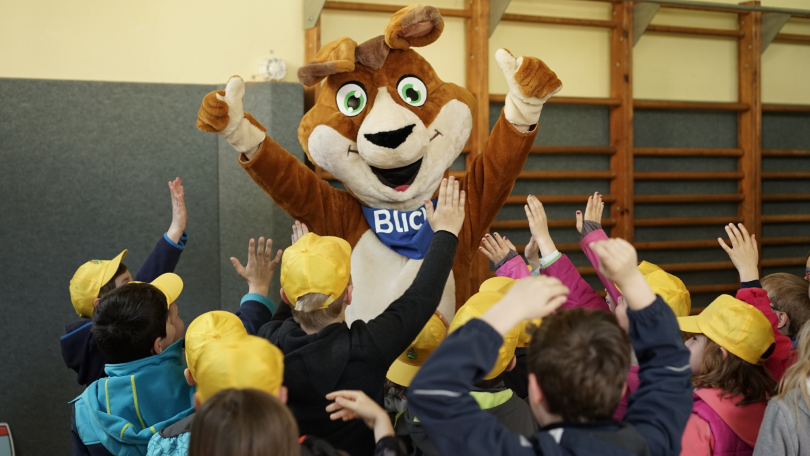
Source: Dirk Hendler, Blicki e. V.
At school events, Blicki the Kangaroo teaches primary school children about the dangers that arise when close to large vehicles. ‘Blicki blickt’s’ not only provides teachers with teaching material to prepare school events but also supports schools in organizing and following up on such events.
The main attraction is a truck demonstrating how a whole school class can disappear in the truck’s blind spot. Pupils can sit in the truck driver seat and see for themselves, so that in the future they will be able to better assess the danger that a turning vehicle poses.
Furthermore, they practise how to behave correctly and carefully when they are near large and heavy vehicles in road traffic or there are visual obstructions.
The programme was evaluated by the Federal Highway and Transport Research Institute. The measure is currently being revised on the basis of these findings. More information on “Blicki blickt’s” (German only).
‘School route maps made easy’
Source: Bundesanstalt für Straßenwesen
School routes should be as safe as possible for all children. To make sure that parents know the safest route, every school should have a school route map. A school route map identifies safe crossing points, danger spots and how to behave there, as well as safe routes from the children’s homes to school.
The Federal Highway and Transport Research Institute (BASt) has developed a guide on how to draw up a school route map. This guide is targeted at parents, schools, local authorities, police forces and everybody intending to draw up school route maps. It contains important information and useful sources to draft a good school route map yourself relatively easily and cost-efficiently.
The “School route maps made easy” guide (German only) can be ordered from the Federal Highway and Transport Research Institute or downloaded from its website free of charge (German only).
Only the right way is the safe way: ‘Children in cars’

Source: Federal Highway Research Institute
In Germany, children under 12 years of age and less than 150 cm tall have to use a child car seat suitable for them when riding in a car. 93 percent of all children riding in cars in built-up areas use age-appropriate child car seats.
However, surveys show that only 52 percent of the children are properly secured in the child restraint system.
A brochure by the Federal Highway and Transport Research Institute contains information on how to use child restraints in passenger cars and typical mistakes as well as on the different restraining systems.
The “Safety for Children in cars” brochure (“Kindersicherheit im Auto”) can be ordered from the BASt or downloaded from its website (German only).
Carrying children on cargo bikes
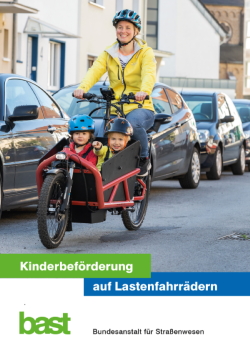
Source: Federal Highway Research Institute (BASt)
Cycling has become extremely popular. As a result, the use of cargo bikes has also increased, be it for carrying groceries or children. The Federal Highway and Transport Research Institute has published a brochure with tips on what to bear in mind with cargo bikes from the first test ride to their day-to-day use. Readers can find an overview of useful features the bike should have when it comes to carrying children, helping them find the right bike. The brochure also contains practical exercises for using the cargo bike properly, which should be tried before using the bike on the roads.
The “Carrying children on cargo bikes” brochure (“Kinderbeförderung auf Lastenrädern”) can be ordered from the BASt or downloaded from its website (German only).