


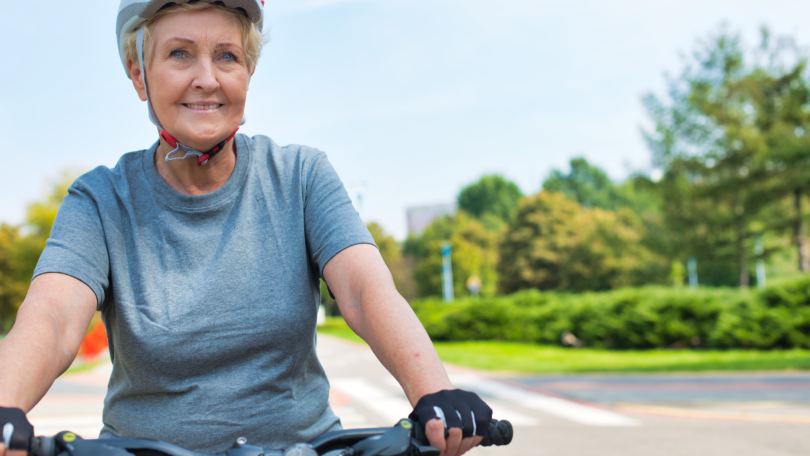
Source: Adobe Stock / moodboard
In 2025 , more than half of the cyclists and pedestrians killed in accidents (61.9 percent) were at least 65 years old. Of all passenger car occupants killed in accidents, nearly one in three (34.2 percent) belonged to this age group. As road users, senior citizens are particularly at risk. Among the reasons for this are the increased vulnerability of senior citizens and also changed cognitive and motor skills, which require an appropriate response. Therefore, it is important to raise awareness among senior citizens of possible risks and how to avoid them. At the same time, younger road users are also called upon to act with care and anticipation towards the elderly. The Federal Ministry of Transport (BMV) supports various actions and schemes.
“Staying mobile but safely!” adventure days on safer mobility in old age
Life is colourful. This is also the way the ‘Staying mobile but safely!’ road safety days organized by the German Accident Prevention Organization (DVW) present themselves. Be it accidents involving a turning vehicle or safe cycling, the use of pedelecs and the benefits of wearing a helmet, or a fatigue and intoxication goggles course, reaction, vision or hearing tests, the safe use of a rollator or visibility in road traffic – all these issues are addressed at the ‘Staying mobile but safely!’ events organized by the DVW. Participants can test their skills without obligation on a number of activity instruments such as a motor vehicle simulator.
The road safety days are offered in many different locations all over Germany: at village and town fairs, on senior citizens' days or at senior citizen community centres. They are offered free of charge, and no prior registration is required.
In road traffic, you have to act quickly and safely. Brain teasers and regular exercise help to keep you physically and mentally fit and mobile. A lot of tips and suggestions on this can be found in media offered by the DVW, such as the brochures “Mobile and active with brain jogging” (mobil & aktiv mit Gehirnjogging) and “Mobile and active exercise fun” (mobil & aktiv Bewegungsspaß). They are available free of charge in the DVW media shop (German only).

Source: German Accident Prevention Organization (DVW) | 
Source: German Accident Prevention Organization (DVW) |
More information on “Staying mobile but safely” (in German).
“Safely mobile”: everyone in their own way

Source: German Road Safety Council (DVR)
Whether elderly people are out and about by car, bike, pedelec, on foot or with a rollator – preserving their safe mobility is the objective of the ‘safely mobile’ courses offered by the German Road Safety Council (DVR). Every participant receives support in correctly assessing their capabilities and developing individual compensatory mechanisms. During these courses, senior citizens are exposed to hazardous road traffic situations that are typical of those they are likely to encounter at their age, address new rules and their personal physical and cognitive requirements. In the free of charge events, trained facilitators address individual concerns and interests of the participants and have practical advice ready at hand. More information on the ‘Safely mobile’ programme can be found here (German only).
Drivers of motor vehicles aged over 65

Source: German Road Safety Council (DVR) | 
Source: German Road Safety Council (DVR) |
The German Road Safety Council (DVR) makes available project material to raise awareness among drivers of motor vehicles of changes related to their age that may have an impact on their driving skills. The prevention campaign centres on ‘health checks’ and ‘feedback rides’ in old age. The materials available also include a guide for the right way to address the issue of driver fitness with elderly family members as well as a comprehensive brochure (in German) on the subject “Getting older and staying AUTOmobile”. More information on the campaign can be found here (German only).
“Fit by bike”: The training programme for cyclists and pedelec riders.
Pedelecs, which are bicycles assisted by an electric motor that can reach a speed of up to 25 km/h, are very popular among senior citizens. Unfortunately, the share of fatal accidents involving a bike or a pedelec is particularly high. Bicycle training courses can help improve motor skills of senior citizens so they can better handle their bicycles or pedelecs. The one-day training course “Fit by bike” is carried out with qualified support by the DVW. The numerous exercises and practical tips for people riding bicycles or pedelecs are not only fun, but also enable participants to practice safe handling of their bike and in traffic. More information on the training programme for cyclists and pedelec riders (in German).
Safely mobile with the rollator

Source: Stephanie Donath / cyanopolis
Being mobile means maintaining contacts, running errands and gaining new experiences - in short: participating in life independently and actively. However, mobility restrictions can occur with increasing age. Depending on the severity of the impairment, rollators can be a useful way of maintaining individual mobility. In order to be able to travel safely with the rollator in traffic and to avoid accidents as far as possible, a few basic tips should be taken into account. This DVR brochure, which was created with the support of the Federal Ministry of Transport, contains a wealth of information on choosing the right rollator, individual adjustments, suitable accessories and the safe use of the rollator in road traffic. More information can be found in the brochure “Safely mobile with the rollator” (German only).

Source: Stephanie Donath / cyanopolis
Safely mobile with wheelchairs and motorized hospital elevators
Participation in public life and therefore in road traffic is often difficult for persons with locomotive challenges. Besides physical exertions, overcoming obstacles and especially covering longer distances are often not possible without the help of other people. For this reason, persons with ambulatory disabilities and, in some cases, elderly, physically impaired persons are often dependent on a wheelchair or a motorized invalid carriage. These can help when it comes to shopping independently, visiting friends and family or attending a doctor’s appointment. However, switching to a wheelchair or motorized invalid carriage often poses new challenges for making everyday journeys. This DVR brochure, which was supported by the Federal Ministry of Transport, provides information on the applicable rules in road traffic. It also contains numerous tips and guidance on adjustments and seating position and answers basis questions regarding safely participating in road traffic with a wheelchair or motorized invalid carriage. More information can be found here (German only).