


Source: BMV
General aspects on road safety
Whether on foot, by bike, motorbike or car – a mobile society relies on safe road traffic. According to data provided by the Federal Statistical Office, 2,832 persons were killed in road accidents in 2025. Despite the drop in the number of road fatalities by more than 80 % since 1970, every person killed is one too many.
The Federal Government has therefore kick-started its road safety activities in order to get one step closer to ‘Vision Zero’ – zero fatalities on the road. The goal is to achieve a decline in road fatalities by 40 percent by 2030 while at the same time reducing the number of serious road traffic injuries.
To this end, the Federal Government, the federal states and the municipalities launched the Road Safety Pact in 2021. For more information on the Road Safety Pact please refer to www.paktfuerverkehrssicherheit.de (in German only).
What are the key propositions of the programme?
Road safety is a top priority for the Federal Ministry of Transport. Since 1973, the Ministry has been laying out its planned measures and projects in a road safety programme about every ten years. This makes the road safety programme the Federal Government’s contribution to implementing the Road Safety Pact.
As opposed to previous programmes, the current road safety programme is no longer a rigid plan, but a vital and evolving process that is to be continuously reviewed and adapted. With this broad approach, the Federal Government wants to involve the federal states and local government associations as well as the expert community in associations, institutions and companies even more than before.
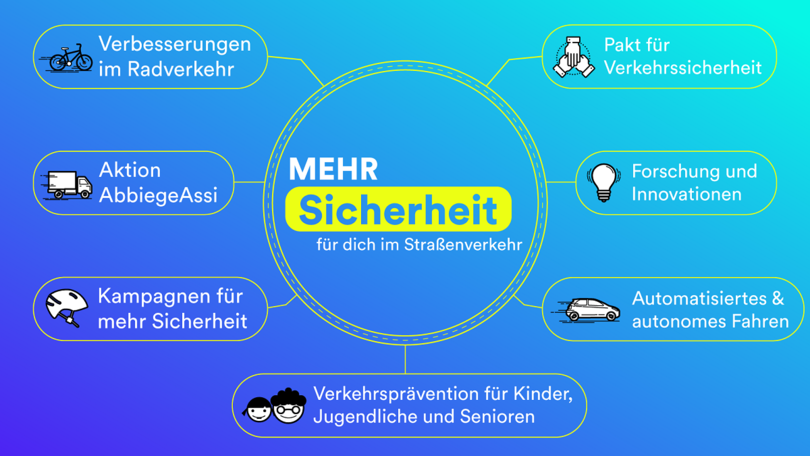
The Federal Government has launched the new decade of road safety focusing on the following areas:
- Actively harness the potential of automated, autonomous and connected driving to improve road safety: According to official road accident statistics, over 90 percent of accidents are caused by human error. Communication between individual vehicles or between vehicles and infrastructure allows to recognize dangerous situations in time and consequently prevent accidents.
- Driver assistance systems: The Federal Government will support the uptake and efficient use of driving assistance systems in motor vehicles, motor bikes, HGVs, buses and coaches and promote public acceptance.
- Improving road infrastructure: A key element in improving road infrastructure is knowledge transfer about locally effective measures. The Federal Government plans to provide innovative tools to this end. This includes, for example, the development of an electronic road safety inspection tool for the inventory of traffic signs.
- Road safety as part of the cycling campaign: The segregation of transport modes has a crucial role to play here. For this reason, the Federal Government wants to continue to push ahead with the construction of safe cycle tracks.
- Expanding the collection of accident data and improving the data basis: If we have more insight into specific accident causes, we can develop tailored measures. Many cycling casualties are the result of single vehicle accidents that do not involve other road users. These cycling accidents are often not recorded by the police.
- Road safety programme – evolving and vital: The Federation evaluates its road safety activities every other year. To this end, the accident prevention report, which is submitted every two years, has been expanded to include comprehensive monitoring. One element is the collection of road safety indicators which, in addition to the established accident and accident victim statistics, can help indicate changes in the level of safety in individual areas of the road transport system.
What is the Federal Ministry of Transport doing to improve road safety?
The Ministry has already implemented numerous measures to improve road safety. For instance, the German Road Traffic Regulations (StVO) have been amended to give the federal states and local authorities more leeway and make it easier to impose speed limits at playgrounds, busy school routes and pedestrian crossings. In addition, a ban on disabling emergency brake assist systems for motor vehicles over 3.5 tonnes travelling at speeds above 30 km/h has been introduced. The amendment came into force on 11 October 2024.
- Since 2019, financial assistance has been provided for more than 38,000 turn assist systems purchased in the context of the ‘Turn Assist Scheme’ with the help of more than 240 safety partners, including all major grocery chains. Further companies, local authorities and organizations have already expressed their interest in safety partnerships. The scheme is constantly being expanded.
Since 7 July 2024, the installation of turn assist systems in new vehicles has been mandatory in accordance with EU Regulation 2019/2144. Since 1 July 2024, turn assist systems for heavy goods vehicles (existing vehicles) have been subsidized exclusively through the Turn Assist System Funding Programme in accordance with a ministerial decree. This also applies to motor vehicles used for freight transport subject to toll that had previously applied for corresponding funding under the ‘US’ (formerly De-minimis) funding programme. More information can be found here. - Our Ministry provides assistance to the federal states and local authorities with various promotion and funding programmes to make room for attractive and safe cycling that is least and financial assistance programmes for cycling have been secured for the longer term, until at al Areas 2029 (cycling pilot projects and German Cycling Network) and 2030 respectively (Cities and Rursegregated from private motorized transport as much as possible. The investment special programme). More information can be found here.
- The Federal Ministry of Transport provides 15.4 million euros annually for the prevention of road accidents. Here, you can find more information on the individual road safety projects and campaigns.
Where do we go from here? We are closing a pact!
In line with the guiding principle ‘Safe mobility, everyone joins in’, we combine our efforts to bring road safety activities to a new level. The Road Safety Pact forms the umbrella under which stakeholders can implement their measures, and under which further activities, platforms or forums can run.
In this context, the German Road Safety Council DVR (Deutscher Verkehrssicherheitsrat e.V.) provides our Ministry with considerable support.
The activities of all stakeholders to improve road safety will be presented the DVR website in stages www.paktfuerverkehrssicherheit.de (in German only). Interested parties will find information on exciting projects and upcoming events there.
A DVR staff member is available to answer any questions personally.