


Source: AdobeStock / karelnoppe
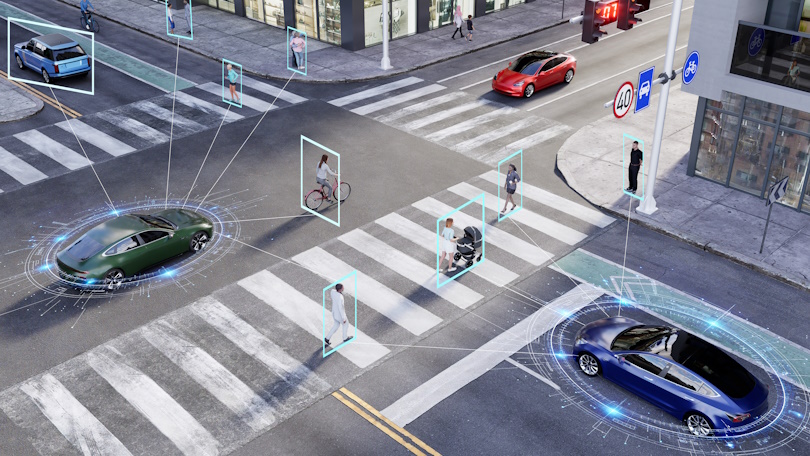
Mandatory introduction of vehicle safety systems can further reduce the number of road fatalities and injuries. This makes a crucial contribution towards increasing road safety.
Examples of vehicle safety systems
Advanced emergency braking systems
Advanced emergency braking systems are proactive driver assistance systems that warn the driver of potential collisions and independently activate emergency braking if necessary. This can in particular help to avoid rear-end collisions with HGVs.
For more information, visit: https://www.bmv.de/SharedDocs/EN/Articles/StV/Roadtraffic/emergency-braking-systems.html
Emergency lane-keeping systems
Passenger cars and light commercial vehicles must be fitted with systems that assist the driver in keeping the vehicle safely in lane or maintaining a safe distance from the road boundary. The systems warn drivers when a lane departure is about to occur and intervene if the vehicle leaves its lane.
For more information, visit: https://www.bmv.de/SharedDocs/DE/Artikel/StV/Strassenverkehr/automatisiertes-spurhaltesystem.html
Intelligent speed assistance systems
Regulation (EU) 2021/1958 states that all motor vehicles are to be equipped with systems to help the driver to comply with the statutory speed limit. The system provides dedicated, appropriate and effective feedback to draw the driver’s attention to the fact that the applicable speed limit has been exceeded.
Driver drowsiness and attention warning system
All motor vehicles are to be equipped with systems that analyse driver attention and warn drivers if necessary.
Reversing detection systems
In order to avoid collisions with persons and objects behind the vehicle, reversing systems and vehicle requirements with regard to the detection of vulnerable road users behind the vehicle are being introduced.
Collision avoidance systems
Buses, coaches and HGVs must be equipped with advanced systems that are capable of detecting pedestrians and cyclists in close proximity to the front or nearside of the vehicle and of providing a warning or avoiding collision with such vulnerable road users.
Event data recorders
In the future, passenger cars and light commercial vehicles plus buses, coaches and heavy-duty vehicles will have to be fitted with event data recorders. In the event of an accident, this recorder captures anonymized vehicle driving data in conformity with the EU data protection provisions. The findings derived from the data facilitate more detailed accident research and targeted development of automotive engineering requirements, increasing road safety.
Emergency stop signals
Passenger cars, buses, coaches and commercial vehicles have to be equipped with emergency stop signals. This is a light-signalling function to indicate to other road users behind the vehicle that the vehicle ahead of them is braking hard for the prevailing road conditions. The terms ‘emergency stop signal’ and ‘emergency stop light’ are often used for the same function. The signal is given by the simultaneous operation of all the stop or direction indicator lamps fitted to the vehicle. The emergency stop signal is automatically activated when the vehicle speed exceeds 50 km/h and the vehicle decelerates very rapidly, or the anti-lock braking system (ABS) is activated. The emergency stop signal goes out after the very rapid deceleration and/or after the ABS has been deactivated.
Tyre pressure monitoring systems
In the future, all trailers with a maximum authorized mass of more than 3.5 tonnes as well as all commercial vehicles, buses and coaches will have to be equipped with accurate tyre pressure monitoring systems. The purpose of these systems is to warn drivers of a loss of tyre pressure.
Until now, it has only been mandatory to fit passenger cars with these systems.
Enlarged head impact protection zone
In the future, passenger cars and light commercial vehicles will have to be designed and constructed to provide for an enlarged head impact protection zone with the aim of enhancing the protection of road users (for instance pedestrians, cyclists and motorcyclists) and mitigating their potential injuries in the event of a collision.
Improving direct vision for drivers of heavy-duty vehicles
Requirements are being introduced to improve the direct vision of drivers of buses, coaches and heavy-duty vehicles to enhance the direct visibility of vulnerable road users from the driver’s seat. The requirements are designed to minimize the blind spots in front and to the side of the vehicle and reduce accidents involving vulnerable road users.
Turn assist systems
The Federal Ministry of Transport supports the installation of turn assist systems.
Turn assist systems are available technical solutions that can save the lives of road users. The systems support HGV, bus and coach drivers in critical driving situations, making their work easier, for example with visual or audible signals that alert them of pedestrians or cyclists at risk in the event of a turning manoeuvre.
New applications for funding under the ‘Turn Assist System Funding Programme’ can be submitted for vehicles with a total permissible weight of more than 3.5 tonnes and buses with at least nine seats, as well as freight transport vehicles subject to tolls.
For more information, visit: https://www.bmv.de/SharedDocs/EN/Articles/StV/turn-assist-systems.html