


Source: BMV
Many young at the age of around 15 become increasingly mobile. At that age, they not only take more and longer trips by bike but are also allowed to obtain a driving licence for motor-assisted bicycles, and – limited to use in Germany – for mopeds. In addition, many young people start preparing for the ‘Accompanied Driving from 17’ scheme.
As they widen their range of movement and start motorized driving, the accident rate increases. The casualty figures for young cyclists rise as soon as they transfer to secondary school; moreover, road users aged between 18 and 24 years have by far the greatest likelihood of becoming involved in a road traffic accident. In 2025, 295 young adults were killed in road accidents. This means that 10,4 % of people killed on the roads were aged 18 to 24 years, although only one in 14 of the total population (7.2 %) belongs to this age group.
The Federal Ministry of Transport, together with various partners, has developed a range of schemes for adolescents and young adults that are designed to increase the road safety of young people without limiting the mobility that allows them to conquer the world at that age.
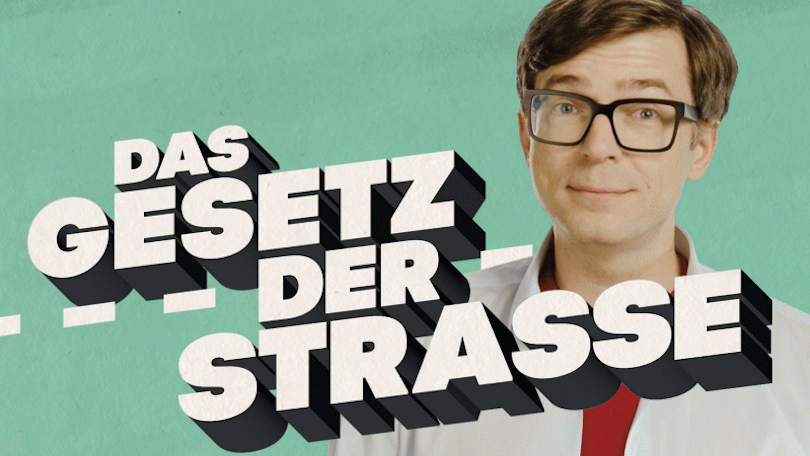
“The Law of the Street” – road safety education with Ralph Caspers
In an online series entitled “The Law of the Street”, Ralph Caspers, the TV presenter known from the youth information programmes “Wissen macht Ah!” and “Sendung mit der Maus”, aims to encourage young road users to think about risks and hazardous situations in road traffic. Of course, he does this with his sense of humour and his pleasant and easy-going way of transmitting information. Additional teaching materials for secondary schools are also provided free of charge for use in the classroom. The units have a modular design and can be used for all school subjects and types; they can thus be adapted to the timeframe and the academic level of the classes. The six teaching topics address the following road safety aspects:
- distraction;
- alcohol and drugs:
- cycling;
- risky behaviour;
- powered two-wheelers; and
- accompanied driving from 17.
The materials can be downloaded free of charge.
‘SERIOUSLY?!’

Source: Federal Working Group for More Safety for Children (BAG) | 
Source: Federal Working Group for More Safety for Children (BAG) |
This campaign deals with the risks of being involved in an accident as a result of being distracted by a smartphone in road traffic and as a pedestrian. The ‘SERIOUSLY?’ initiative aims to prevent real-life accidents in the digital life. It uses flyers displayed at paediatricians’ practices to address parents and make them aware of their role as examples for their children.
Young people are addressed through teaching materials. Work sheets and quizzes contain information on the topic and feature new didactic approaches.
Brand new: Two virtual reality films. This (virtual) experience allows young people to safely experience dangerous situations and therefore learn to better recognize and assess possible dangers as well as develop alternative ways of responding.
Teachers can integrate these ideas in lessons of environmental studies, mathematics and physical education or use them to organize school projects on road safety or for cycle training. The teaching material, including VR glasses and a pop-up counter, is free of cost and can be acquired at the Federal Working Group for More Safety for Children (BAG) website (BAG) website.
‘Young + Safe + Ready to go’

Source: German Accident Prevention Organization (Deutsche Verkehrswacht e. V.)
Road accident statistics show that young drivers are much more likely to be involved in an accident in the nights from Friday to Saturday and from Saturday to Sunday. To effectively counteract these accidents, the German Accident Prevention Organization DVW organizes the ‘Young + Safe + Ready to go’ scheme at schools. The events take place at schools and are conducted by the local accident prevention organization.
Every event consists of two elements:
- the project components for classroom lessons covering the main risks for being involved in an accident (alcohol/drugs, distraction, vehicle safety, etc.) as well as the action day where a drunk buster goggles course, a driving simulator or a rollover simulator make it possible to address accident-related issues.
The stimulating elements are designed to encourage pupils to question their behaviour. In the classroom, they develop alternative and safe behavioural patterns. These events in schools are staged free of charge. More information on the programme can be found here. (German only)
The programme-related teaching material can be ordered through the VerkehrswachtDVW media shop. Digital material can be found under DVW Campus.
‘BF17’– Accompanied driving from 17 and preparing for it after turning 16

Source: German Road Safety Council (Deutscher Verkehrssicherheitsrat e.V.)
Accompanied driving from 17 can reduce the risk of becoming involved in an accident considerably for young drivers. The ‘Accompanied Driving from 17’ scheme is quite simple. At the age of just 16 ½, young people who want to participate in the accompanied driving scheme can register for lessons at a driving school. Here, they take the same driver training as older learner drivers would do for the driver training from 18 years. After passing the theory and practical test and reaching the age of 17, the young persons participating in the ‘Accompanied Driving from 17’ scheme receive a driving test pass certificate. Together with an identity document, the certificate serves as a driving licence for accompanied driving. From that moment, they are allowed to gain driving experience, accompanied by a person who has to meet certain requirements. Further information on the ‘Accompanied Driving from 17’ (BF17) scheme. Further information on the ‘Accompanied Driving from 17’ (BF17) scheme.
„TUNE IT SAFE“: Track&Safety Days

Source: P.AD advertising agency
The Track & Safety Days are driving safety trainings and workshops with automotive experts and inspection authorities designed specifically for raising awareness among tuning enthusiasts aged 18 to 35 for safe tuning and appropriate behaviour. The events take place at six driving safety centres throughout Germany. In 2025, a highlight was the organization of a ladies day. More Information on ‘Track & Safety Days’ (German Only).
In addition to the events, information on safe tuning and the safe use of the roads are provided via a website, social media, a tuning magazine as well as further print media. More information on ‘TUNE IT SAFE’. (German only).